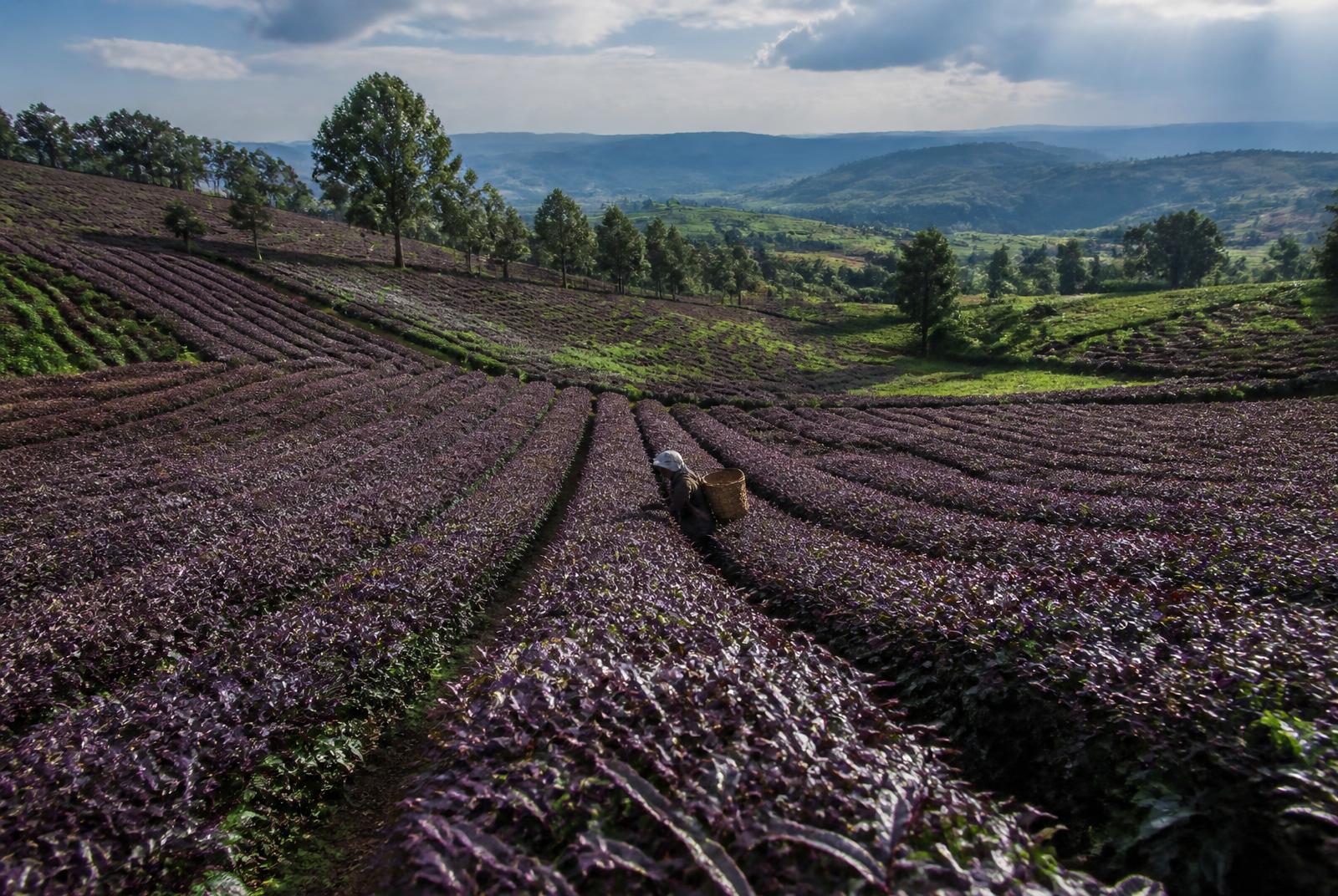
The first surprise is the field itself. Across the contour of the highlands, rows that should read as green turn violet in the shifting light. This is Camellia sinensis, but not as most of the world knows it.
01
A color bred over time
Kenya’s best-known purple tea cultivar, TRFK 306/1, was developed through conventional breeding by the Tea Research Foundation of Kenya and released for cultivation in 2011. Its purple cast comes from anthocyanins—the plant pigments also found in foods such as blueberries.
The distinction matters. Purple tea plants existed elsewhere as botanical mutations; Kenya’s achievement was the patient work of stabilising a cultivar and bringing it into commercial cultivation.
Origin is not a point on a map. It is the meeting of place, patience and knowledge.
02
The highland equation
Tea country here is shaped by altitude, equatorial light, volcanic soils and two rainy seasons. Purple cultivars are grown in several highland regions, from the slopes around Mount Kenya to Nandi, Kericho and Kisii.
A place does not write flavour alone. Variety, plucking, weather and the choices made after harvest all enter the cup. Provenance is the whole chain, not simply the name printed beneath it.
03
Possibility beyond volume
For a tea economy built largely by smallholders, differentiated cultivars offer another path: value connected to distinctiveness rather than scale alone. That possibility is still being worked out field by field.
Rift & Root follows this story because it holds the tension we care about most—heritage and invention occupying the same ground.
Editorial note
This story draws on regional history and published research. It does not claim a named Rift & Root supplier relationship.
- Kenya National Research Fund: purple tea research and growing regions
- Kenya Institute for Public Policy Research and Analysis: purple tea value-chain study
- World Tea News: commercial development of Kenyan purple tea