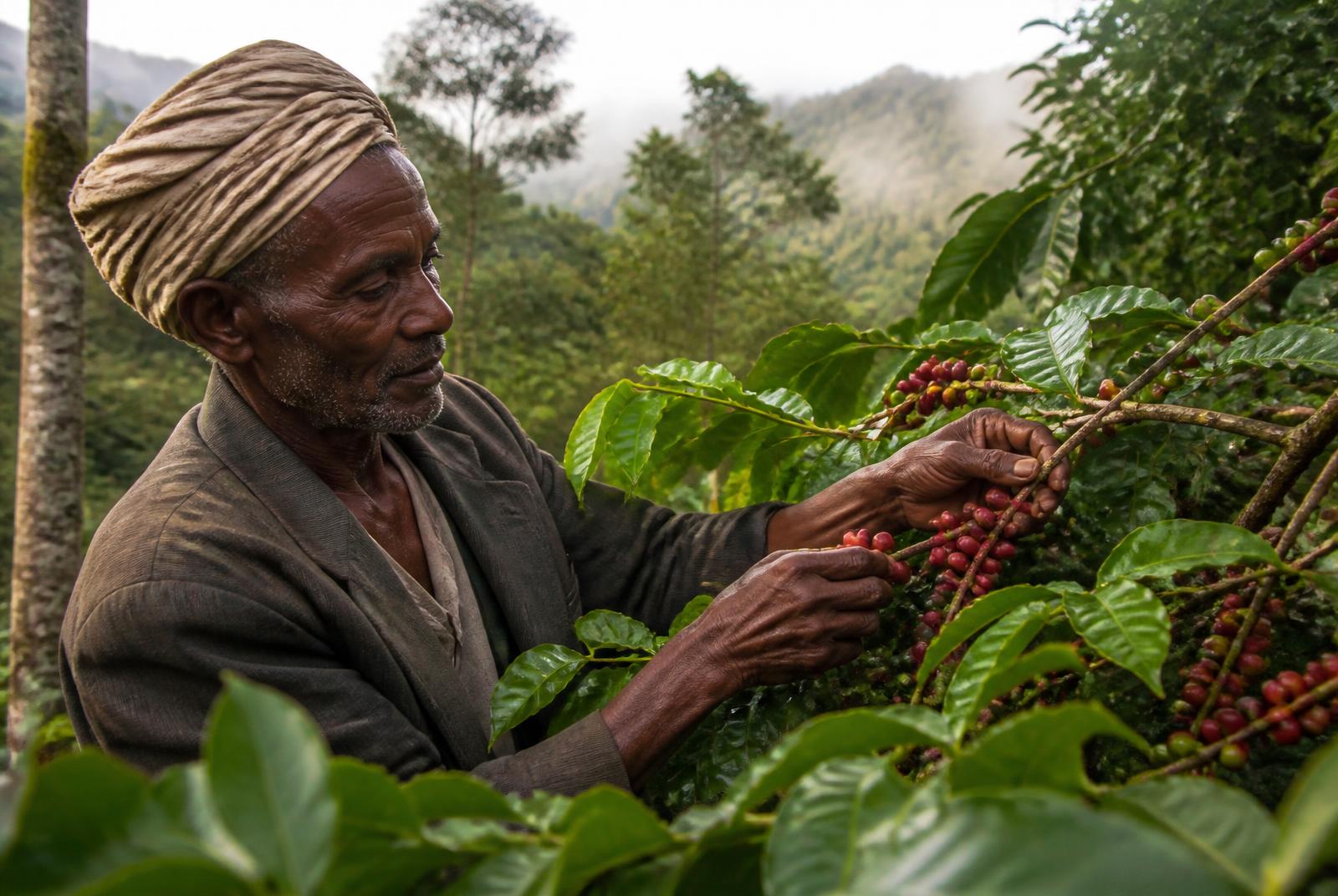
Before the roastery, before the port, before the café, there is a forest. Coffee here grows within a living architecture of shade, moisture and extraordinary genetic diversity.
01
The botanical beginning
The strongest evidence places wild Coffea arabica in the montane forests of southwestern Ethiopia. These forests hold a depth of genetic diversity found nowhere else—a living library for one of the world’s most traded crops.
The often-repeated tale of Kaldi and his dancing goats is a much later literary legend, first recorded outside Ethiopia. The botanical story is quieter and more consequential.
The future of coffee may depend on the forests where its wild story began.
02
A landscape of many coffees
Names such as Kaffa, Jimma, Sidamo and Yirgacheffe describe broad and varied territories, not single flavours. Forest, semi-forest, garden and farm systems each bring different relationships between coffee, canopy and community.
Altitude matters, but so do varieties, ripeness, processing and local knowledge. To reduce Ethiopian coffee to one tasting note is to miss the scale of its diversity.
03
A reserve for the future
As climate pressure narrows the conditions in which Arabica can thrive, wild and locally adapted populations become increasingly important. Conserving the forest is not nostalgia; it is crop resilience.
The question is economic as much as ecological: can the value of coffee return sufficiently to the communities whose stewardship keeps that genetic inheritance alive?
Editorial note
This story draws on regional history and published research. It does not claim a named Rift & Root supplier relationship.
- Center for Coffee Studies: botanical origins of Arabica
- Filter Stories: Ethiopia’s wild coffee forests
- Historical sources on the documented emergence of coffee drinking